How I Went From Doubting A 5km To Loving A 10km
Jennifer Lindsay-Finan’s Story
If you'd told me at the start of this year that I would run a 10K and enjoy every minute of it, I wouldn't have believed you.
In February, I completed my first 5K through Steve's 0-5K group. Crossing that finish line felt incredible, but if I'm honest, 5K still felt hard. Some weeks it still felt impossible. So the idea of doubling that distance seemed completely insane.
Then I joined Steve’s Run Better group.
Everyone seemed to be signing up for marathons, half marathons, and bigger challenges. Looking at them, I started wondering if maybe I could do something that felt big and scary too. The Perth 10Km was local, familiar, and lots of the group would be there. August felt a long way away. Maybe, just maybe, I could get there.
Why I Asked for Coaching
I'd tried following plans before. Like a lot of people, I'd downloaded generic training plans from the internet or created my own. The problem wasn't finding a plan, the problem was sticking to one. Life would get in the way, I'd miss sessions, get frustrated with myself, decide I'd failed, and then stop altogether. At one point I even got up, got dressed for a run, couldn't decide where to go, and ended up eating crumpets instead.
What I needed wasn't more information. I needed guidance, structure, accountability, and someone who understood me well enough to adapt the plan when real life happened.
That's why I asked Steve to create a program for me.
What I liked immediately was that it wasn't a one-size-fits-all training plan. It was built around my life, my holidays, my schedule, and my current fitness level. He gave me one month at a time, adjusting as we went. There was never pressure to do more than I could realistically manage. In fact, when I went on holiday, his advice was simple: run if you feel like it, but if you don't, it won't make any difference.
That took away a lot of the guilt that usually comes with training plans.
The other thing that surprised me was that the programme wasn't just about running. Alongside the runs, Steve gave me simple exercises designed for me. They weren't generic "runner strength" exercises or endless squats. They focused on the things that were actually holding me back, like loosening a stiff back after sitting at a desk all day and improving how my body moved between runs. It felt less like following a plan and more like having someone in my corner who genuinely wanted me to succeed.
The Plan Helped, The Coaching Changed Everything
The structure was useful. The accountability was useful too. It's harder to ignore a run when someone is going to ask how it's going, and Strava and parkrun results don't leave much room for creative storytelling. Looking back, the biggest breakthrough wasn't physical, it was mental.
In August, just a couple of weeks before the race, I had a coaching conversation with Steve that completely changed how I approached running. I expected him to tell me I needed to increase my mileage. I thought he might even suggest that 10K wasn't realistic this year. Instead, we barely talked about training at all.
We talked about identity. We talked about how I wanted to feel crossing the finish line, talked about visualising success, talked about “running like the person I’m becoming”.
He asked whether I still saw myself as a previous version of myself, or whether I was ready to start seeing the person I was becoming. He encouraged me to create a clear picture of success and practise stepping into that version of myself every time I ran.
It sounds simple, but it was incredibly powerful.
Becoming a Runner Before the Race
A couple of weeks before the event, something shifted.
I started visualising myself running the route and crossing the finish line. I organised my race outfit, even got my nails done to match my running top. That might sound a bit vain, or even silly, but every time I looked at them, they reminded me that I wasn’t someone hoping to run a 10K. I was running a 10K.
I also changed the way I talked about it.
Instead of saying, "I'm supposed to be running a 10K, but I'll probably walk it" or "I'll probably come last," I started saying, "I'm running a 10K with some friends."
That was a surprisingly important difference.
The Power of Community
One of the biggest factors in completing the 10K, was the people around me.
The Run Better group has created a sense of belonging that's hard to describe. In one of my journal entries I called it "collective effervescence" after hearing the term in an audiobook. Whatever the proper definition is, that's what it feels like. A group of people sharing the same experience and making each other better.
Many members are much faster than me. Some are training for marathons, some for ultras. Some run 10Ks for fun! I'm still often one of the slowest runners there, but nobody treats me like I matter less because of that.
We celebrate each other's wins, whether that's a marathon PB or simply getting out for a run when motivation is low. We laugh a lot. We support one another. And gradually, I stopped feeling like the slowest runner in the group and started feeling like a runner who was part of the group.
That sense of belonging matters more than any training session.
Race Day
On race day, I ran the whole thing. Not only did I run 10K, I genuinely loved it!
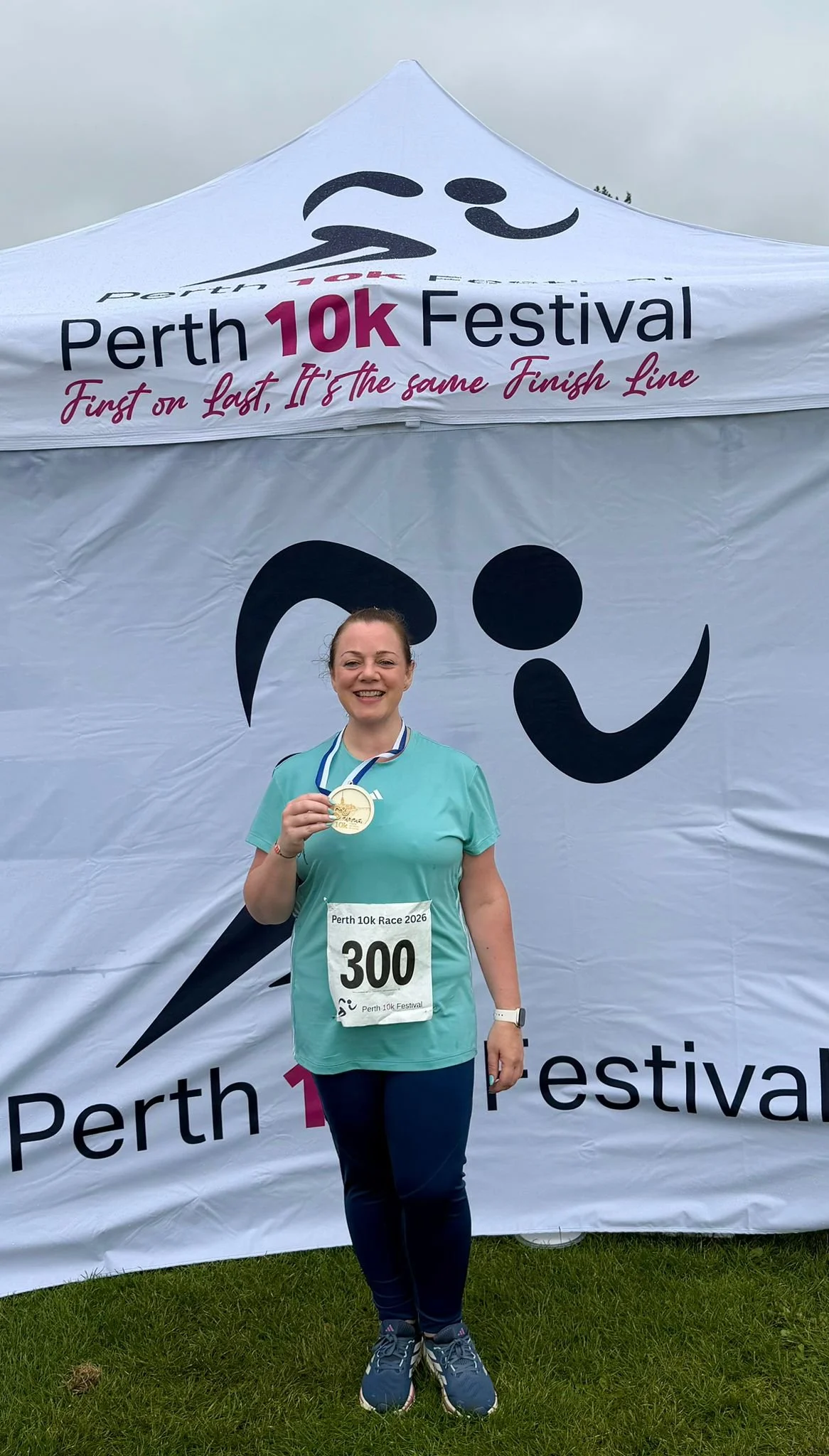
Jennifer with her medal after completing the Perth 10k
I ran most of the race alongside friends from the club. When one friend pushed ahead, I kept going. When the route got harder, I kept going. When part of me wanted to slow down, I kept going.
As I reflected afterwards, I realised something important.
The training helped, the new running gear probably helped, my matching nails definitely made me smile but the mindset mattered most.
I wrote in my journal: "I decided I would, so I did."
Why This Time Was Different
Looking back, I think this is why previous training plans never really worked for me.
The running itself was only part of the challenge. Most of the battles were happening in my own head. I was comparing myself to faster runners, worrying about being last, and putting pressure on myself to do everything perfectly.
What helped most wasn't having a perfect programme. It was having someone who adapted everything to where I was actually at. Sometimes that was a running session. Sometimes it was exercises for my back after a day at the desk. Sometimes it was adjusting the plan around holidays. Sometimes it was a conversation that completely changed how I was thinking.
Somewhere along the way, I stopped being someone who hoped she might run a 10K one day and started being someone who genuinely believed she could.
By the time I stood on the start line, I already felt like a runner.
I ran all 10K. Every step. And – I loved it.
If you’re feeling inspired after reading Jennifer’s story, get in touch, perhaps I can help you achieve something pretty special too!